This sermon was preached for All Saints' Day at St. Andrew's in Wellesley, Massachusetts. The readings for this sermon were: Daniel 7:1-3,15-18, Psalm 149, Ephesians 1:11-23, and Luke 6:20-31.
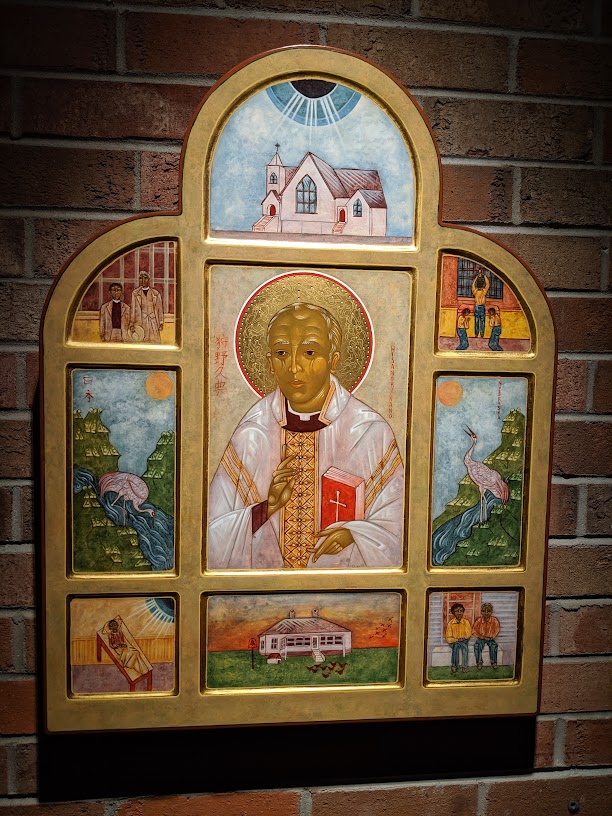
1908. Okinawa, Japan. My husband’s great-grandfather, just nineteen at the time, lay dying in a hospital bed. As he drifted in and out of consciousness, he heard his doctors declare him a hopeless case. He felt a nurse try to find his pulse and fail. But then, Hisanori Kano felt a sense of calm, a vision of light.
“What I saw became God, to me,” he said later. Hisanori’s condition dramatically improved. His doctor, a Christian, proclaimed it a miracle.
After his recovery, Hisanori sought answers in the Bible, in Christian classmates at school. Although raised Buddhist in a country that was less than 1% Christian at the time, Hisanori was baptized Hiram Kano that next year. From that moment on, Hiram was determined to follow God’s purpose for his life, the life he knew God had saved for a reason.
Following God’s call on his life led Hiram to the United States, to Nebraska, where he began organizing the nascent Japanese-American community, teaching farming, English, and, most importantly to him, the good news of Jesus Christ. Bishop Beecher recognized Hiram’s leadership and passion for the Gospel, and in 1936 Hiram became Father Kano, a missionary priest for the Episcopal Church to the Japanese-American community in Nebraska.
This is a powerful story. The story of a man whose life flowed from his gratitude for God’s blessing. See Father Kano left behind more than his native land; he surrendered a prestigious and privileged status as a Japanese nobleman to take up a simple life of farming and prayer.
Yet had this been all of Father Kano’s story, I’m not sure my husband’s great-grandfather would have been declared a saint by the Episcopal Church in 2015. I’m not sure he would have been honored with his own feast day or a special collect or have an icon of him hung in a Nebraska church. What made Father Kano a saint is what he did with what came next.
On Sunday, December 7, 1941, after celebrating Eucharist, Father Kano was arrested on the steps of his church and imprisoned, along with thousands of other Japanese-Americans in the wake of the Pearl Harbor bombing. This was a moment of deep shame for Father Kano, an act of betrayal by his beloved adopted homeland. He wrote: “We had committed no crime, yet we were imprisoned and our human rights taken away. This was truly an unendurable humiliation.”
And yet, in the same breath as he describes the camps, the guards and searchlights, being stripped of his possessions and given a criminal number, in that same paragraph, Father Kano writes, “at the same time this camp was indeed the work given me by God…I made a firm resolution to go about His business.”
“God gave me five churches,” Father Kano writes—the five internment camps Father Kano was moved to throughout the war. And in each, he preached and prayed and pastored with his people. Through his tireless efforts, a whole generation of Japanese-Americans were brought into the Episcopal Church, learned English, and began to organize for the right to become naturalized citizens.
There are too many extraordinary stories of Father Kano’s bravery and compassion in camps to recount today. But when I reflect on the Gospel this morning, I find myself returning to the story of that first “church,” as he called it, that first camp in Sparta, Washington in 1942.
There, Father Kano was the only Japanese-American thrown into a military cell with German-Americans and court-martialed American soldiers. “I could see in their eyes that I was a hated enemy foreigner,” Father Kano wrote. And yet, he resolved to be their priest. He listened to their problems and buoyed their spirits, preached to them and prayed for them. A graduate of Hitler Youth came to him in spiritual crisis. An American deserter sought advice and prayers for his trial. One of Father Kano’s own prison guards asked to attend his prayer services. His church community grew. And when the government came to move him to another camp, the men who had seen him as the enemy pleaded with tears in their eyes for him to stay.
Jesus preached, Love your enemies, do good to those who hate you, bless those who curse you, pray for those who abuse you...If anyone takes your goods, do not ask for them again.
In his obituary in the Rocky Mountain News in the late eighties, Father Kano’s bishop recalled the priest’s reaction to the US government’s recent decision to pay financial reparations to World War II internees. “He told me, ‘Bishop! I don’t want the money. God just used that as another opportunity for me to preach the gospel.’”
Father Kano’s stance of gratitude was not a case of all’s well that ends well attitude, or a wise all-is-forgiven view from three decades on. In the very midst of being seen as the enemy, Father Kano resolved to view himself as blessed. During the five years of the war when he was treated as a criminal, and the two years following when he and his family were reviled and persecuted by their neighbors—during all that time, Father Kano relentlessly reached out with the hands of Christ to do the work of a pastor, of a missionary. Of a saint.
Jesus preached, Blessed are you when people hate you, and when they exclude you, revile you, and defame you. But woe to you, Jesus warns, who equate God’s love with wealth or a full belly or temporary joys. Woe to those whose trust in God depends on comfort and circumstance, because it will be easily lost.
Father Kano knew God’s blessing was deeper—in his life itself. Father Kano’s conviction that God had called him to the camps gave him the strength to love the very people who rejected him, to create church wherever he was sent. His determination, his sense of blessing that could not be shaken, that’s what gave him the ability to do the work that needed to be done.
Faith is more than just the stance we choose to take in the world. It is also getting down to the work itself. Jesus preached, Love your enemies, do good to those who hate you, bless those who curse you, pray for those who abuse you. Love. Do good. Bless. Pray.
Today, we honor those who have walked this way of love ahead of us. But the saints are not just alive in our memories, their stories and legacies. Our faith proclaims the saints are present here gathered, at this table, in each Eucharistic meal. We affirm today that we are the living members of a mystical body, one that is defined not by the temporary blessings of this world, nor the curses of our enemies, but by the love of God, poured out. Unified by moments of divine clarity in hospital beds and baptismal fonts and makeshift prison cell altars. Our sainthoods, yours and mine, spring from those moments when each of us know, fully know, that we are Christ’s own, forever.
Comments
Post a Comment